How to budget as a couple without fighting about money
A calm, practical way to set up a shared budget with your partner: what to share, what to keep separate, and a 20-minute monthly check-in that keeps you on the same page.


Money is one of the most common things couples argue about, and it's rarely about the numbers themselves. It's about surprises, feeling judged, and not knowing what the other person is spending. The good news: most of that friction comes from the setup, not from either of you. Get the setup right and the conversations get much easier.
This guide walks you through a simple system that works whether you earn the same, earn very differently, or one of you is between jobs.
1. Start with a no-blame money conversation
Before any spreadsheets or apps, sit down for 30 minutes and answer three questions each, honestly:
- What does money mean to you? Security, freedom, fun, helping family?
- What worries you most right now? Rent, debt, not saving enough, family requests?
- What would "doing well" look like in a year? An emergency fund, a holiday, a deposit, school fees covered?
Don't solve anything yet. The goal is to understand each other. Many couples discover they want the same things but have been talking past each other.
The rule for this conversation: no judging past spending. You're designing the future, not reviewing the past.
2. Decide what's shared and what's yours
There's no single right model. Pick the one that feels fair to both of you:
| Model | How it works | Works well when |
|---|---|---|
| All shared | All income goes into one pot; everything is paid from it | You have similar spending habits and full trust |
| Proportional | Each person contributes the same percentage of income to shared costs | Your incomes are quite different |
| Yours, mine and ours | A shared pot for joint costs, plus personal money each person controls | You value some independence |
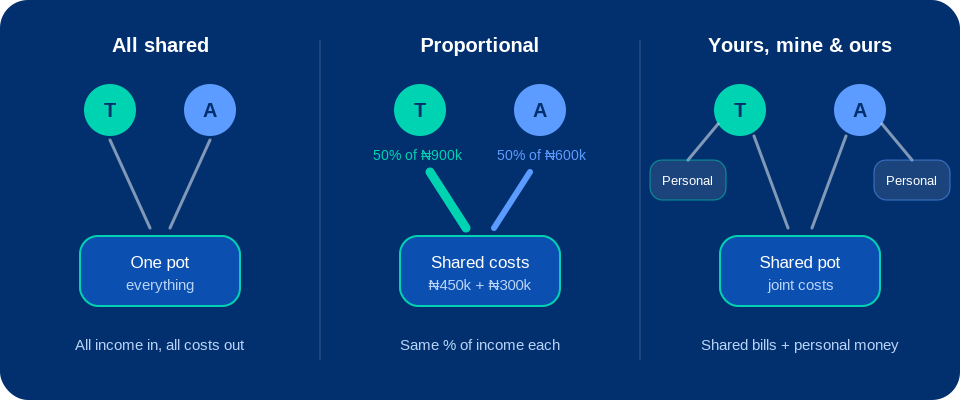
For most couples, "yours, mine and ours" causes the fewest arguments. Shared bills come from the shared pot, and each of you has personal money you can spend without asking or explaining.
Example (proportional): if one partner earns ₦900,000 a month and the other ₦600,000, and your shared costs are ₦750,000, each contributes 50% of their income: ₦450,000 and ₦300,000. Both give the same share of what they earn, which tends to feel fairer than a straight 50/50 split.
Try it with your own numbers:
Try it: your fair-share calculator
Each of you puts 50% of your income into shared costs:
A straight 50/50 split would be ₦375,000 each, which is 63% of the lower income.
Calculated in your browser. Nothing you type is saved or sent.
3. List your shared costs
Write down everything you pay for together, and how often:
- Every month: rent or mortgage, electricity, internet, groceries, transport, data.
- Less often: school fees, insurance, car servicing, festive season and family events.
- Goals: emergency fund, holiday, a deposit, a new car.
Turn the "less often" costs into a monthly figure. If school fees are ₦600,000 a term, that's roughly ₦200,000 a month to set aside, so the bill doesn't land as a shock.
4. Set budgets you both agree on
Now give each shared category a monthly limit. Keep it simple at first: five to eight categories is plenty. A useful starting point is the 50/30/20 idea:
- about 50% for needs (housing, food, bills, transport);
- about 30% for wants (eating out, entertainment, shopping);
- about 20% for saving and goals.
Adjust it to your reality. In a high-rent city, needs might be 60%. That's fine, as long as you've both agreed to it.
5. Give each person personal money, no questions asked
This is the step that prevents most fights. Agree on a personal allowance for each of you every month. It can be equal, or proportional to income. Whatever it is, neither person has to justify how they spend it. New trainers, a game, a gift for a friend: it's theirs.
6. Hold a 20-minute monthly money check-in
Once a month, sit down together (ideally with tea, not stress) and run through:
- How did we do? Look at each shared budget: under, on track, or over.
- Any surprises? Unexpected costs, and whether to plan for them next time.
- Goals: how close are you, and do you want to change the target or date?
- Next month: anything big coming up, such as a wedding, travel or school resumption?
Keep it short and regular. Small, frequent conversations beat one big blow-up every few months.
7. Make it visible to both of you
Most money tension comes from one person not being able to see what's happening. Whatever tool you use, both of you should be able to see the shared money, and each change should be easy to trace.
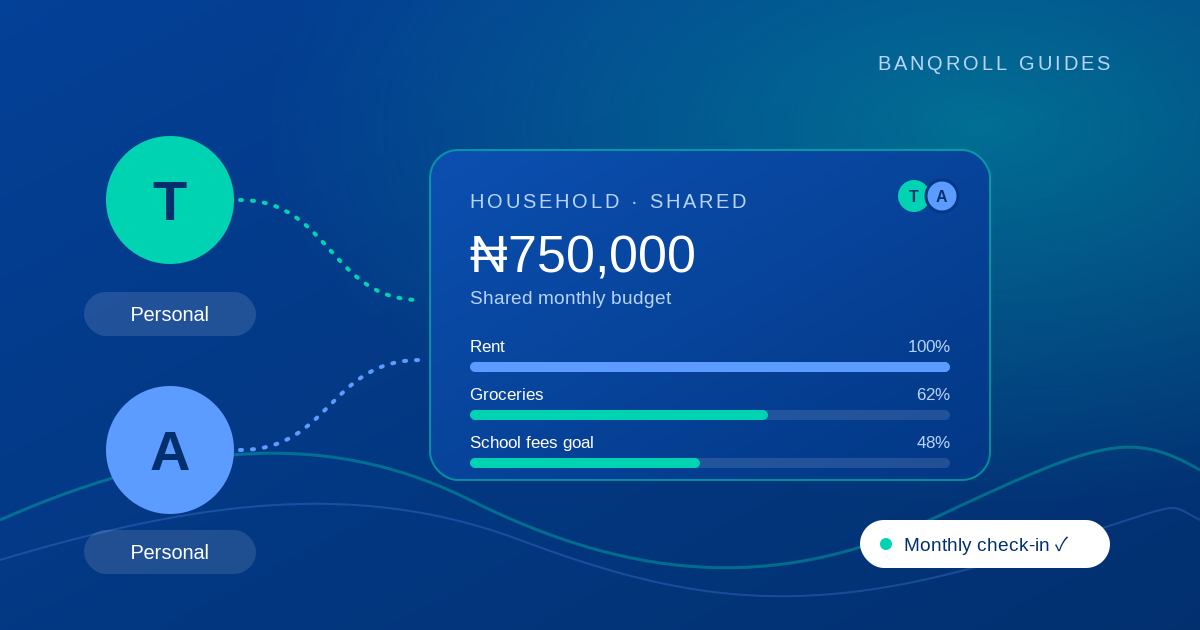
In Banqroll, you can share a whole account or just the wallets you choose, and give each person a role: an Owner has full control, a Manager handles day-to-day adding and editing, and a Viewer can see without changing anything. You can set weekly or monthly budgets with alerts before you go over, track shared goals, set up recurring bills with reminders, and ask Tally questions like "How much did we spend on food last month?" Every addition, edit or deletion on a shared account is recorded in an Activity Log the owner can review, so there's no guessing who changed what.
8. If you earn in different currencies
Many couples have one income in naira and another in pounds, dollars or euros, or send money home to family abroad. Keep each currency in its own wallet, and record transactions in the currency they actually happened in. Banqroll supports 51 currencies and keeps the exchange rate from the day each transaction was recorded, so your past totals don't shift every time rates move.
A simple checklist to start this week
- Have the no-blame money conversation.
- Choose your model: all shared, proportional, or yours, mine and ours.
- List shared costs and turn yearly costs into monthly amounts.
- Agree five to eight budget categories and limits.
- Agree personal money for each of you.
- Put a monthly 20-minute check-in in both your calendars.
Budgeting as a couple isn't about controlling each other. It's about agreeing on the plan once, so you don't have to argue about it every week.
This guide is general information to help you organise your money. It isn’t financial, tax or legal advice for your situation.
Do this together in Banqroll
Shared wallets, budgets and goals for the people you manage money with. Join the waitlist and we’ll tell you when it opens.